Yacht passage time,
with clear assumptions.
Explore the time behind a yacht itinerary. Set a distance, choose an average speed, and include the stops you expect.
Use this page to compare your own cruising scenarios before you discuss the route with your skipper.
DISTANCE / SPEED / TIME
Yacht passage time calculator
Enter the route distance in nautical miles. Enter average speed over ground in knots. Speed over ground means progress relative to the earth, rather than through the surrounding water. Use an estimate for the whole route, including slower sections. Add time for stops separately.
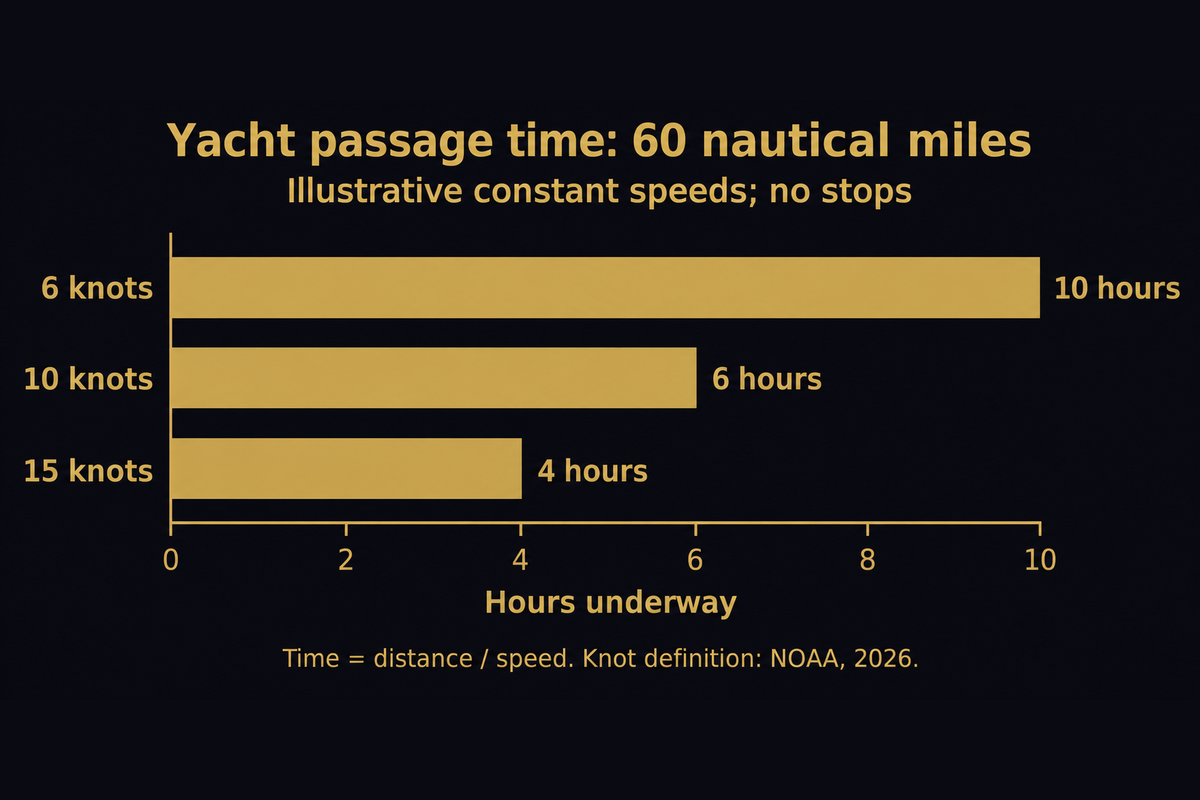
Method: underway hours = nautical miles ÷ knots. Total hours = underway hours + stop hours. NOAA’s National Ocean Service (2026) defines one knot as one nautical mile per hour. Results round to the nearest minute. Input limits are calculator limits, not vessel limits.
The starting values describe an example, not a recommended yacht speed or an actual route. The tool uses only your inputs. It does not retrieve weather, tides, charts, or vessel performance. Treat the result as a timing estimate, not a navigation plan.
BUILD YOUR SCENARIO
Turn a yacht itinerary into useful questions
Start with the route you intend to discuss. Write down the departure berth, destination, proposed stops, and the distance for each leg. Keep those notes beside the calculator. A place name alone does not provide enough information for this tool. It needs a distance that you supply.
For a yacht charter, ask the skipper which distance and average speed to enter. Record the assumptions with the result. Keep the same distance when you compare speeds. Keep the same speed when you compare different routes. This approach makes each change easy to explain to the other people on the trip.
Separate travel from time at anchor
Use the stop field for time when the yacht makes no progress along the route. For example, a 60 nautical mile scenario at 10 knots gives 6 hours underway. Adding a 1.5-hour stop gives 7 hours 30 minutes in total. These are arithmetic examples, not estimates for a named yacht.
Include slower movement in the average speed instead of counting it again as a stop. If you cannot choose a useful average for the entire route, calculate each leg separately. Add those leg times and the stops in your own notes. Do not average different leg speeds and assume that the answer will match.
Compare an alternative before you settle on a plan
Try a lower average speed while you keep the other inputs unchanged. Then compare a shorter distance with the original speed. Save both sets of assumptions in your notes. The calculator does not save a trip history. Its output shows duration only, so it does not apply a departure date, time zone, or daylight-saving change.
For a return journey, enter the full distance if your speed assumption applies throughout. Otherwise, calculate the outward and return legs separately. Do not treat the single-leg result as the whole outing. Keep waiting time and time ashore visible in your notes so that everyone uses the same itinerary.
BEFORE DEPARTURE
Check more than the arrival estimate
The UK Maritime and Coastguard Agency’s MGN 599 Amendment 1 (2024), section 7.4, identifies these passage-planning considerations:
- Check the forecast and tidal predictions.
- Consider the vessel’s limits, equipment, and stores.
- Consider the crew’s experience and physical ability.
- Identify navigational hazards and places of refuge.
- Give someone ashore your plans and an action plan for concerns.
That guidance also recommends navigation skills and information that do not depend entirely on GPS. An arrival estimate answers a narrow question. It does not establish whether a passage suits the yacht, the crew, or the conditions.
Sources and scope
NOAA, National Ocean Service: “What is the difference between a nautical mile and a knot?” Updated 2026. Maritime and Coastguard Agency: “MGN 599 (M) Amendment 1,” updated 2024. Raymarine: “Navigation glossary,” revision 6, accessed 2026, defines speed over ground and speed through water. The examples on this page use the stated formula and hypothetical inputs. This page does not predict yacht prices, racing outcomes, or weather.